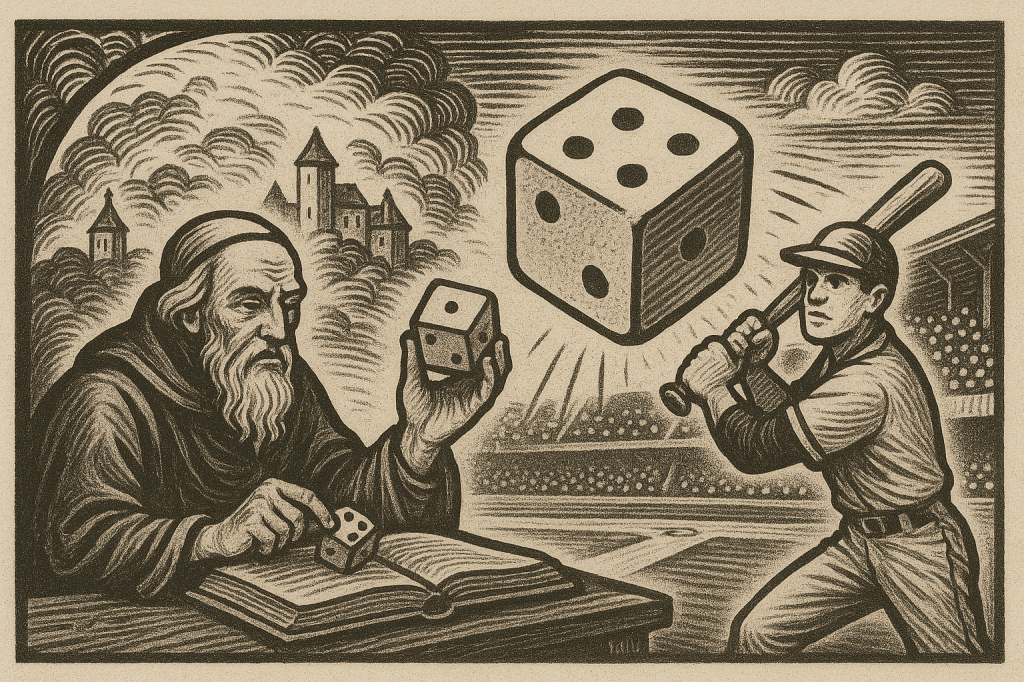
How a 13th-century probability calculation became America’s favorite tabletop pastime
When you roll dice to simulate a baseball game, you’re participating in a tradition that stretches back further than you might imagine—not just to the early days of professional baseball, but to medieval Europe, where scholars were first grappling with the mathematics of chance. At Pocho & Papa, we believe understanding this rich history makes the games we play today even more meaningful.
The Medieval Origins: De Vetula and the Birth of Probability
Our story begins around 1260 CE with a Latin poem called De Vetula (“On the Old Woman”). Written in France, possibly by the English polymath Roger Bacon, this seemingly obscure medieval text contains something remarkable: what scholars now believe to be the first documented probability calculation in Western history.
Hidden within the poem’s narrative is a methodical enumeration of all 56 possible sorted combinations when rolling three dice—from 111 to 666. The manuscript presents these combinations in a visual table, creating what modern historians recognize as an early representation of a probability distribution. The poem explicitly connects the number of combinations to the expected frequency of dice outcomes, establishing a mathematical framework that wouldn’t become common knowledge for another four centuries.
Even earlier, in the 10th century, Bishop Wibold of Cambrai had explored these same 56 combinations, associating each with canonical virtues in a game that combined theology with mathematics—from 111 representing charity to 666 representing humility.
What makes this medieval mathematics so fascinating is how it anticipated modern game design. These scholars understood intuitively what game designers would rediscover centuries later: that sorted three-dice combinations create a probability space rich enough for complex simulations while remaining simple enough to use at a table.
The conceptual breakthrough of De Vetula wasn’t just about counting combinations—it was about understanding that different outcomes had different likelihoods, and that this could be precisely calculated. For nearly a millennium after De Vetula, this knowledge circulated among scholars and gamblers, passed down through manuscripts and practical experience, waiting for someone to apply it to simulating the great American game.
Baseball Meets Dice: The Early Years
Fast forward to the late 19th and early 20th centuries. Professional baseball was capturing America’s imagination, and almost immediately, fans wanted to bring the game home. The earliest baseball board games were simple affairs—generic mechanisms where every batter had the same chance of getting a hit, regardless of whether you were Babe Ruth or a journeyman utility player.
The breakthrough came in 1930 with Clifford Van Beek’s National Pastime. Van Beek translated real-life statistics to individual player cards, so for the first time, Ruth would bash home runs on your tabletop just as he did at Yankee Stadium, while other players performed according to their actual abilities. It was revolutionary—and the Great Depression nearly killed it before it could take hold.
The Golden Age: APBA and Strat-O-Matic
A decade later, the floodgates opened. In 1941, major league player Ethan Allen designed All-Star Baseball, using spinners and player cards to recreate baseball action. Then in 1951, J. Richard Seitz launched APBA (American Professional Baseball Association), working out of his living room in Lancaster, Pennsylvania.
APBA introduced a system that would influence baseball game design for generations: players rolled two dice, consulted individualized player cards, and referenced outcome charts that varied based on base situations and pitcher quality. The game wasn’t just simulating baseball—it was simulating the strategic depth of baseball. Base states mattered. Pitcher quality mattered. Context was everything.
But the true revolution came in 1961 when Hal Richman, a mathematics student at Bucknell University, released Strat-O-Matic Baseball from his basement. Richman’s innovation was elegant and profound: instead of rolling 2d6 and reading the sum (which creates a predictable bell curve), Strat-O-Matic used 3d6 where one die determined which card to consult (batter or pitcher) and the other two dice created the result.
This approach gave card designers unprecedented control. Unlike earlier dice systems where high rolls always meant good things for the batter, Strat-O-Matic’s results were unpredictable—roll triple sixes and you might get a home run, or you might get a double play. Every roll felt like a new adventure because the probability distribution was less predictable than traditional 2d6 systems.
Strat-O-Matic would become the best-selling sports board game of all time, and both APBA and Strat-O-Matic continue to thrive today, passed down from father to son, played in leagues with dedicated communities that replay entire seasons and hold annual conventions.
The Modern Renaissance: Accessibility Meets Innovation
For decades, APBA and Strat-O-Matic dominated the baseball simulation market. But the 21st century has brought a renaissance of dice baseball design, with new games embracing different philosophies about what makes baseball compelling at the tabletop.
- Deadball: Baseball With Dice (2017) by W.M. Akers represents the modern minimalist approach. Using a standard set of polyhedral dice (d4, d6, d8, d12, d20, and percentile dice), Deadball simulates a complete game in about 20 minutes. It uses statistics every fan understands, allowing players to create teams from any era of baseball or design fictional leagues from scratch. Deadball’s elegance lies in its accessibility: you can learn it in minutes, but its fast-paced gameplay and intuitive character creation system make it endlessly replayable.
- Baseball Highlights: The Dice Game (2020) from Eagle-Gryphon Games takes a different approach, turning baseball simulation into a simultaneous roll-and-write experience. Players draft dice and string together combos to score runs, creating a fast-paced game where everyone stays engaged even when it’s not their turn. It’s baseball through the lens of modern board game design—streamlined, strategic, and built for game night rather than season-long replays.
- Pocket Pennant Run (2021) represents the ultra-portable end of the spectrum—a full-fledged baseball simulation that fits in your pocket. Using simple charts and an intuitive multi-point rating system, it brings historical teams to life while remaining simple enough to learn in minutes. With companion software featuring databases of over 300,000 players, it bridges traditional tabletop play with modern digital conveniences.
- 7th Inning Stretch (2025) by Gabe Barrett offers a unique solo experience, combining card drafting and dice rolling where you serve as GM, manager, and players. With its nostalgic baseball card aesthetic and engine-building mechanics, it captures the dream of building and managing your own championship team, playing out the critical final innings of key games across a season.
The Homebrew Spirit Lives On
Beyond published games, there’s a thriving community of homebrew designers creating their own baseball dice systems. Online forums buzz with discussions of custom charts, modified probability tables, and experimental mechanisms. Designers share their creations freely, iterating on century-old ideas and inventing new approaches.
This homebrew spirit is itself a tradition going back to Van Beek and Seitz—people who loved baseball enough to spend years perfecting dice systems in their living rooms, not for profit but for the pure joy of bringing the game to life on their kitchen tables.
At Pocho & Papa, our own Triple Six Baseball – The Dice Game is part of this proud tradition. Using the same 56 sorted three-dice combinations that appeared in De Vetula 750 years ago, we’ve created a system that honors both medieval mathematics and modern game design principles—fast play, meaningful decisions, and moments that stick with you.
Why Dice Baseball Endures
In an age of sophisticated video game simulations like MLB The Show and Out of the Park Baseball, why do dice baseball games persist? Why do thousands of people still gather at conventions, still roll physical dice, still fill out paper scoresheets?
The answer lies in something fundamental about the human experience. Rolling dice creates moments of anticipation and drama that even the most advanced computer simulation can’t quite replicate. There’s something about holding those dice in your hand, watching them tumble, and seeing the result that connects us to centuries of game players before us—from medieval scholars calculating probabilities to fathers teaching their sons how to keep score.
Dice baseball games also offer something video games struggle to provide: complete transparency. You can see exactly how your player’s statistics translate to game outcomes. You can modify rules, create house variants, design your own teams. The game is yours to shape, not locked behind proprietary code.
And perhaps most importantly, dice baseball games create shared experiences. They’re social in a way that solo video game play isn’t. They’re tactile in a way that digital interfaces aren’t. They’re portable—you can play at the kitchen table, on a camping trip, or during a long winter evening when the ballparks are buried in snow.
The Thread That Connects Us
From Bishop Wibold’s virtue game in the 10th century, through the probability calculations of De Vetula in the 13th century, to Van Beek’s breakthrough in 1930, to the golden age of APBA and Strat-O-Matic, to today’s modern renaissance of accessible, innovative designs—there’s a thread connecting all of us who roll dice to simulate baseball.
We’re part of a tradition that combines mathematics and sport, chance and strategy, historical simulation and imaginative creation. We’re honoring the scholars who first understood probability theory, the designers who first translated baseball to dice, and every parent who ever taught their child how to keep a scorecard.
At Pocho & Papa, when we sit down to design a new baseball game, we’re conscious of this lineage. We’re not just making a game—we’re continuing a conversation that started in medieval Europe and found its perfect expression in modern baseball.
The dice keep rolling. The tradition continues. And somewhere, in a kitchen in Canada, in a basement in Boston, in living rooms around the world, baseball lives on—one roll at a time.
 Pocho & Papa
Leave a comment