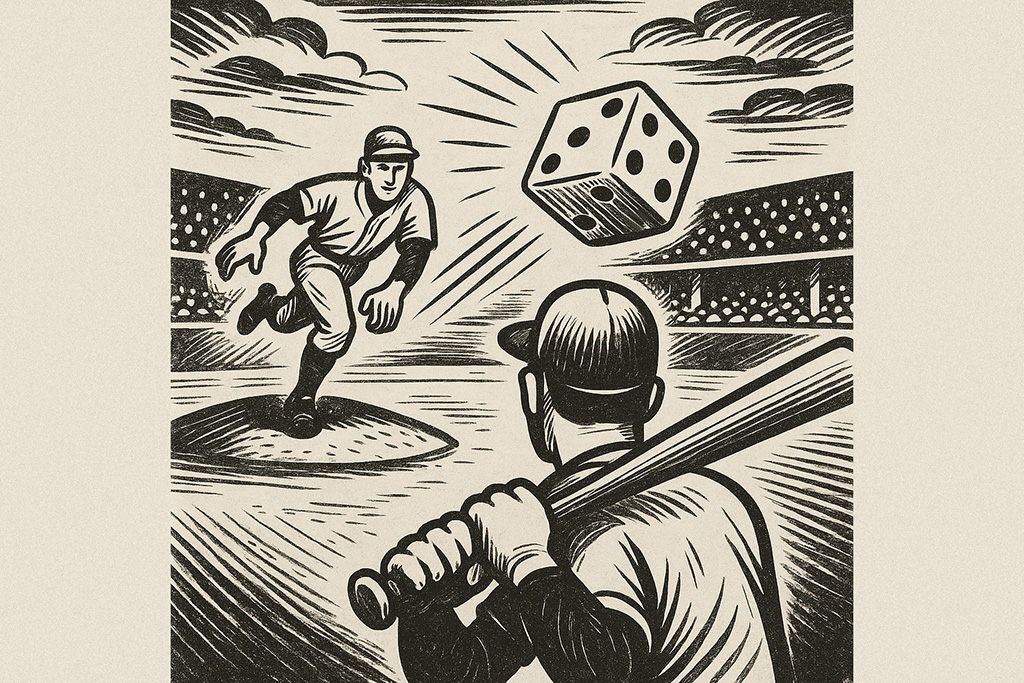
A designer’s perspective on probabilities, pacing, and the beautiful mathematics of baseball
Baseball and dice have been partners for over a century, but that doesn’t mean the design space is exhausted. Far from it. Every time we sit down to design a baseball dice game, we’re working within a fascinating constraint: how do you capture the rhythm and realism of baseball while keeping the game moving at a pace that respects players’ time?
At Pocho & Papa, we’ve spent countless hours rolling dice, crunching numbers, and tweaking probability tables. Today, I want to pull back the curtain on some of the design thinking behind our games—specifically Triple Six Baseball—and explore why dice baseball remains such a rich and rewarding design challenge.
The Magic of 3d6
When most people think of dice games, they think of 2d6—the familiar bell curve that powers everything from Monopoly to Settlers of Catan. Roll two dice, you get results from 2 to 12, with 7 as the most common outcome. It’s elegant, intuitive, and deeply embedded in gaming culture.
But for baseball simulation, we chose 3d6 instead. Here’s why that matters.
With 3d6, you’re not just adding the dice—you’re reading them as a sorted combination. When you roll 4-1-3, you sort it to 1-3-4, giving you result 134 on your outcome table. This creates exactly 56 unique combinations (from 111 to 666), each with its own probability.
The beauty of this system is the probability distribution. Unlike 2d6’s smooth bell curve, 3d6 sorted combinations create a more nuanced probability landscape:
- Triple dice (111, 222, 333, etc.) are rare—only about 2.78% each
- “Low” rolls like 112 or 113 are more common—around 8.33% each
- “Middle” combinations like 234 or 345 sit around 16.67%
- The spread feels less predictable than 2d6, but more controlled than 1d56
This distribution gives us incredible design flexibility. We can make triple sixes (666) a home run—it’s rare enough to feel special but common enough that you’ll see a few in a series. We can make common rolls like 123 or 234 produce outs, ensuring the game flows at a realistic pace. And we can sprinkle exciting moments throughout the probability space without breaking the simulation.
The Three-Column System: Context Matters
Real baseball isn’t just about the batter’s skill—it’s about situation. A ground ball with bases empty is an easy out. That same ground ball with a runner on first? Now it’s double play territory. With runners in scoring position, that grounder might score a run.
This is why Triple Six Baseball uses a three-column outcome table:
- Bases Empty – Clean slate, standard outcomes
- Runner on 1st – Double play risk, aggressive baserunning opportunities
- Runners in Scoring Position – Sacrifice flies, clutch hitting moments
The same roll produces different results depending on context. Roll 146? That’s an out with bases empty, a double play with a runner on first, and just a single out with runners in scoring position. This isn’t just realistic—it creates meaningful tactical decisions. Do you bunt to advance that runner? Do you attempt a steal to get into scoring position where the outcome table is more favorable?
Balancing Realism with Playability
Here’s the central tension in baseball game design: real baseball averages hover around .250 to .270 for batting average, with teams scoring roughly 4-5 runs per game. If you make your dice game too realistic in its statistical output, you risk creating an experience that’s tedious—lots of outs, not much action.
But if you make it too generous, you lose the tension that makes baseball compelling.
Our solution in Triple Six Baseball was to create two versions of the outcome table:
- Hitter-Friendly: Batting average runs slightly higher, with more aggressive baserunning opportunities (the ++ Single) and generous triple-dice moments. This version prioritizes fun and memorable moments over strict statistical accuracy.
- Pitcher-Friendly: Batting average closer to realistic MLB levels, fewer hits with runners on first, and even the dreaded 666 produces a double play when there’s a runner on first only—a dramatic gut-punch moment that perfectly captures baseball’s cruel beauty. Games are tighter, lower-scoring affairs for players who want that tension.
The key insight? Different players want different experiences. Some want the thrill of big innings and exciting plays. Others want the grinding, defensive chess match of a 2-1 pitcher’s duel. By tuning the probability tables, we can serve both audiences without changing the core rolling mechanism.
The “Triple Dice” Moments
One of our favorite design choices was making the triple-dice rolls (111, 222, 333, 444, 555, 666) into memorable moments:
- 111 (Three Aces): A walk—patient at-bat, bases-loaded tension
- 222 (Three Deuces): Double—solid extra-base hit
- 333 (Three Treys): Triple!—perfectly thematic
- 444 (Three Fours): Double—another power hit
- 555 (Three Fives): Double or aggressive baserunning
- 666 (Triple Six): Home Run!—the ultimate payoff for our game’s namesake
These rolls happen roughly once every 36 rolls (2.78% each), which means in a typical game, you’ll see maybe 3-4 of them. Just rare enough to feel special, just common enough to create stories. When you roll 666 with the bases loaded? That’s a moment you remember.
Why 2d6 for Special Plays
You might notice that bunts, steals, and pickoffs use 2d6 instead of 3d6. This is deliberate.
These plays are binary gambles—they either work or they don’t. The 2d6 bell curve gives us that perfect distribution:
- 2 and 12 (2.78% each): Extreme outcomes—disaster or triumph
- 7 (16.67%): The most likely result—moderate success
- Everything else: A smooth gradient of risk
For steals, this means most attempts (5-9 on 2d6) succeed, but there’s meaningful risk (2-4 = caught). For bunts, the sacrifice bunt (5-9) is the most common outcome, but you might get lucky with a bunt single (10-11) or unlucky with a pop-up (2).
Using a different dice mechanism for these special plays also creates cognitive distinction. When you declare a bunt or steal, you’re entering a different mini-game with its own risk profile. It feels different, and that’s intentional.
The Design Philosophy
At the heart of all this math and probability is a simple philosophy: respect the player’s intelligence and time.
We don’t need 20 different dice types or complex modifiers for every situation. We don’t need 200-row outcome tables that require a magnifying glass to read. We don’t need to track pitch counts and individual batter statistics (though you can if you want to).
What we need is a system that:
- Plays fast (20-30 minutes per game)
- Feels like baseball (outs dominate, but exciting moments punctuate the action)
- Creates meaningful decisions (when to bunt, steal, or swing away)
- Produces memorable stories (that bases-loaded triple six home run)
The math serves the experience, not the other way around.
The Beautiful Constraint
Designing dice baseball is like writing a sonnet—the constraints are what make it interesting. You have limited tools (dice, probability tables), and you’re trying to capture something enormously complex (the strategic depth and emotional rhythm of baseball).
Every design choice ripples through the system. Make singles too common, and bases get clogged. Make outs too frequent, and games drag. Make home runs too rare, and you lose excitement. Make them too common, and they lose meaning.
Finding that balance is where the art lives.
At Pocho & Papa, we’re constantly tweaking, testing, and refining. We roll thousands of dice, track dozens of games, and iterate on our tables. We debate whether a roll of 345 should be a single or an out with a runner on first. We test whether the steal table needs rebalancing. We argue about whether 666 with a runner on first should really be a double play (it should, and it is, in the pitcher-friendly version—it’s brutal and perfect).
This is the design space we love. Simple tools. Deep possibilities. And always, always, the sound of dice hitting the table, followed by that moment of anticipation before you check the chart.
That’s baseball. That’s dice. That’s why this design space will never get old.
Triple Six Baseball is available as a free print-and-play on our website. If you’re a designer interested in discussing dice baseball mechanics, probabilities, or play-testing approaches, we’d love to hear from you. Drop us a line or share your own design insights in the comments.
 Pocho & Papa
Leave a comment